Monday, July 4, 2011

The “Horrid and Unnatural Rebellion” of Daniel Shays


The “Horrid and Unnatural Rebellion” of Daniel Shays

James P. Hodges, Ph.D. and Cynthia F. Hodges, JD, LLM, MA

“What country can preserve its liberties if their rulers are not warned
from time to time that the people preserve the spirit of resistance? … 
The tree of liberty must be refreshed from time to time 
with the blood of patriots and tyrants.”

~ Thomas Jefferson


The smoke of the Revolutionary War had scarcely cleared when desperate economic conditions in Massachusetts led patriot veteran Revolutionary War soldiers and farmers to peacefully protest  excessive state taxes and corrupt state government in 1786. Shays' Rebellion began when 2,000 armed men blockaded the Springfield, Massachusetts courthouse. The uprising showed that when citizens band together, they can successfully win concessions from the government. 
_____________________________________________
In the first years of peacetime following the Revolutionary War, the future of society was threatened by strangling debt that aggravated the depressed economy of the postwar years. Ruinous inflation afflicted the entire nation as the currency became almost worthless. The value of the Continental currency fell to a low of four thousand dollars in paper money to one ounce of silver. The situation became so dire that George Washington complained it took a wagonload of money to buy a wagonload of goods.
The central government that had been set up by the Articles of Confederation had trouble paying  overdue wages owed to veterans, so it delayed paying the benefits it had promised. State governments,  pleading poverty, paid the state militia with IOU’s, promising to redeem them later. Many veterans were forced to sell their IOUs to speculators for immediate cash. Wealthy Tories bought the IOUs, paying pennies on the dollar from desperate veterans. Speculators redeemed the IOUs at face value for silver specie, plus 6% interest, profiting off of the backs of patriots.
Massachusetts may have suffered more than any other colony. It suffered under a staggering $14 million debt and a shortage of specie. Heavy land taxes undermined the fragile financial structure of the hill towns. Destitute farmers often had to borrow money to re-establish their farms after fighting the Revolution. Due to inflation and poor economic conditions, they often lost their farms to foreclosure for failure to pay debts and crushing taxes. Farmers grew indignant as they watched furniture, grain and livestock sold off for much less than their value. Foreclosed farms were confiscated and often sold at one-third of their true value.  With the loss of their means of making a livelihood, farmers often landed in debtors prison. Terrible economic conditions combined with apathetic public officials who were  “thieves, knaves, and robbers” left the people feeling they had no choice but  to take matters into their own hands.

Protests began to break out in 1786, to which the Massachusetts legislature retaliated by suspending habeas corpus, albeit temporarily. It imposed heavy poll and property taxes, amounting to one third of the total income of the people, and imposed new and higher court costs. Foreclosures mounted, and the shadow of debtors’ prison continued to cast a pall. Many citizens of western Massachusetts began to question the benefits of independence. A few even blamed the patriot leaders of 1776 for deluding them. Cheers for King George III were heard once again in towns that a few years before had cursed his name. As the economic and political crisis of the 1780’s deepened, unrest spread. Angry protests erupted.
Reform-minded citizens called “Regulators” met in several western counties during the summer of 1786. They drafted resolutions that they sent to the Massachusetts legislature calling for a variety of reforms. They petitioned for a reduction of court fees, reduction of salaries for state officials, issuance of paper money, relocation of the state capital from Boston (where it was deemed too susceptible to the influence of eastern commercial interests) to a western city, reduction of taxes, redistribution of the tax load, postponement of foreclosures, and fewer imprisonments for debtors. Unfortunately, the legislators were not only unreceptive to their grievances, but were actually enraged. 
Some of the Regulators were Revolutionary War veterans who knew from experience that the people could unseat a tyrannical government by force of arms. Potential leaders could be recruited from former Revolutionary War officers in the Bay State. The first leader to be chosen was Luke Day, “the master spirit of the insurrection.” Day was a former brevet major in the Continental Army. He had both the inclination and the experience necessary to lead a rebellion, but the reluctant rebel, Captain Daniel Shays of Pelham, assumed command. 
Daniel Shays had an impressive Revolutionary War record. He had fought bravely at Bunker Hill. Ticonderoga, Saratoga, and Stony Point. Shays was even honored by receiving a ceremonial sword for meritorious service at Saratoga from the Marquis de Lafayette. After the War, he started farming in the small town of Pelham, where he was elected to various local offices. Shays learned  first hand the problems that beset returning war veterans. He was forced to sell the handsome ceremonial sword that Lafayette had presented to him for cash. In 1784, he was sued for a 12-dollar debt.
With their new leader, citizen groups took up arms, hoping to “encourage” the government to treat them fairly. In late August 1786, following a Hampshire County convention at Hatfield, a gathering  of 1,500 men “armed with guns, swords, and other deadly weapons, and with drums beating and fifes playing” took command of the county courthouse at Northampton and forced the judges of the Court of Common Pleas and General Sessions of the Peace to adjourn. At Great Barrington, in Berkshire County, a group of 800 stopped the court, broke open the jail and released its prisoners. At Springfield, Shays and Day closed the courthouse doors, while at Concord, less than 20 miles from Boston, Job Shattuck prevented the sitting of the Middlesex County court. By early fall, citizen groups  armed with muskets or hickory clubs moved at will through the interior counties. By late November, Regulators entering into Worcester had closed the Court of Common Pleas. In early December, Shays rode in with 350 men. It became obvious that no court could meet without an army to back it up. The Worcester court gathered meekly in the Sun Tavern and immediately adjourned until January 23. The rebels then drafted a petition to the legislature for a redress of grievances and wrote in defense of their actions. 

"If they have real grievances redress them, if possible; 
or acknowledge the justice of them, 
and your inability to do it at the moment. 
If they have not, employ the force of government against them at once. 
Let the reins of government then be braced and held with a steady hand, 
and every violation of the constitution be reprehended. 
If defective, let it be amended, 
but not suffered to be trampled upon whilst it has an existence." 


~ George Washington in a letter to Henry Lee, October 31, 1786 

Massachusetts governor, James Bowdoin, and the legislature responded to the latest outbreaks with a confusing mixture of sternness, concession, and indecision. In early September 1786, the Governor issued his first proclamation, condemning the Regulators as flirting with “riot, anarchy and confusion.” In October, the legislature suspended habeas corpus. Although the government conceded to some demands by authorizing some categories of goods as legal tender for specified kinds of public and private debts, it refused to make concessions on most of the Regulators’ demands. It refused to budge on reforms in court procedures, reduction of the tax load, officials’ salaries, lawyers’ machinations,  or foreclosures or debtors prisons. However, it did offer a full pardon to all rebels who agreed to take an oath of allegiance before the end of the year. 
As the  Regulators  continued protesting through the fall of 1786, officials of other states  voiced concern that the anarchy of Massachusetts might spread to the rest of the nation. John Jay complained he was “uneasy and apprehensive; more so than during the war.” Secretary of War Henry Knox, Massachusetts statesman Rufus King, and others began to have similar apprehensions. They wrote frantic letters to one another, asking for news and predicting disaster. Abigail Adams, then in London, bristled at the “ignorant and restless desperadoes,” while reports of the uprising helped prod her husband, John Adams, into writing his ponderous “Defence of the Constitutions.” By the spring of 1787, observers on both sides of the Atlantic feared for the future of the nation.
To fight the rebellion, the Massachusetts Council authorized a state army of 4,400 men and four regiments of artillery, to be drawn largely from the militia of the eastern counties where state laws were not enforced so harshly.  However, Governor Bowdoin and Knox feared that the powers of state government would not be enough to withstand the protesters. They called for volunteers for the federal army. The result was an additional 1,340 troops added to the federal army of 700. The additional troops were ostensibly to be used against the Indians of the Northwest, but in a secret session, Congress acknowledged that they might be used against the Regulators. 
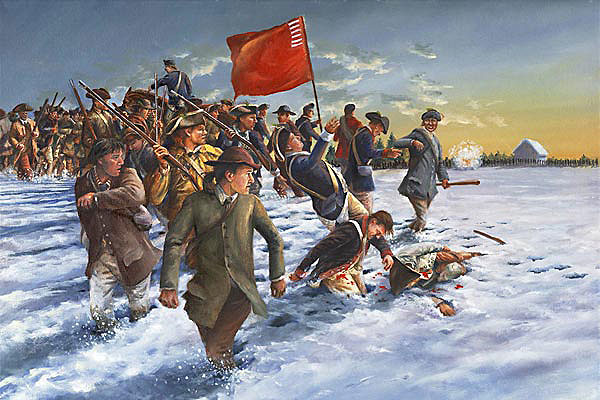
In January 1787, Shays descended upon the government arsenal at Springfield, Massachusetts.  The rebels needed guns and ammunition to fend off troops that were advancing from Boston under General Benjamin Lincoln. The militia defending the arsenal (commanded by General William Shepard) unexpectedly fired their cannon into the ranks of the advancing rebels, killing four and wounding 20. The farmer-veterans did not expect their neighbors, kinsmen  and fellow veterans to fire upon them, and retreated in disarray crying “murder.” 
Shays advanced on Hampshire County, where they hoped to stop the court in Springfield from convening. They also hoped to raid the federal arsenal there. Shays had planned to attack on January 25, 1787, but at the last minute, Day decided to wait until the 26th. His note informing Shays of the change was intercepted by government forces. When Shays followers moved on the afternoon of the 25th as originally planned, the government militia defending the arsenal fired cannon volleys directly into their midst (after two warnings). Three rebels fell dead in the snow, a fourth lay dying. 20 more were wounded.  The rebels scattered without firing a shot.
General Lincoln discussed surrender proposals with Shays, but the rebel leader insisted on an unconditional pardon for himself and his men. Negotiations broke down as Lincoln was not authorized to grant full pardons. Shays retreated to the relative security of Petersham, a center of pro-Regulator sentiment that lay in terrain that was easier to defend. 
Determined to clear his name of the stamp of cowardice gained from the Revolution, Lincoln marched his men thirty miles from Hadley to Petersham through a blinding snowstorm the night of February 3, 1787. Taken completely by surprise, the rebels were routed. 150 were captured. The rest, including Shays, escaped to the north. Lincoln then dispersed rebel nests in the Berkshires. By the end of February 1787, only a scattered resistance remained. What the state legislature had recently unfairly condemned as a “horrid and unnatural Rebellion and War … traitorously raised and levied against this Commonwealth” was over.
While the militia crushed the remnants of the rebellion, the state government drafted a series of punitive regulations. In mid-February, it issued a harsh Disqualifying Act, offering pardons to privates and noncommissioned officers, but denying them for three years the right to vote, to serve on juries, and to be employed as schoolteachers, innkeepers, or liquor retailers. The rebel officers, citizens of other states who had joined the Massachusetts uprising, former state officers or members of the state legislature who had aided the rebels, and people who had attended Regulator conventions would be tried for treason. They would be hanged upon conviction. One Shays rebel, shocked that he would be accused of treason, wrote that he “earnestly stepped forth in defense of this country, and liberty is still the object I have in view.”
The government’s vindictive measures caused widespread protest, not only from those who had sympathized with the rebel cause but from many of its active opponents as well. General Lincoln, among others, believed that such harsh reprisals would further alienate the discontented, and he wrote to General Washington that the disfranchisement of so many people would wholly deprive some towns of their representation in the legislature. New outbreaks would then occur in areas that had no other way to voice their grievances. 
In token concession to its critics, the state legislature appointed a special commission of three men to determine the fate of rebels not covered by the Disqualifying Act in March 1787. General Lincoln served on the commission, and under his moderating influence, it pardoned 790 participants. In the meantime, county courts captured and tried any rebel leaders they could find. In Hampshire County, six men were sentenced to death for their part in the uprising, while in Berkshire County, eight men got the death penalty. Many others were imprisoned or fined.
The April 1787 election that followed revealed the depth of public support for the Regulators and the disapproval of the government’s actions. In the gubernatorial election that year, John Hancock overwhelmingly defeated Governor Bowdoin. 160 of the 222 members of the legislature and 13 members of the 24-man senate lost their seats. Perhaps to prove a point, the voters chose men who had actively participated in the rebellion, including Josiah Whitney, who had recently served 16 days in the Worcester jail.
Within the next few months, the new legislature repealed the Disqualifying Act, reprieved all men under sentence of death —some on the very steps of the gallows— and even Daniel Shays (although he and a few other leaders were still precluded from holding civil and military offices in the state). The legislature enacted long-range reforms, thereby addressing the complaints expressed by the Regulators. For example, it extended the law that permitted the use of certain personal and real property in payment of debts, imposed a lower and more equitable tax schedule, released most debtors from prison, and eased foreclosures laws. 
Thomas Jefferson believed that “the spirit of resistance to government is … valuable on certain occasions.” The “horrid and unnatural Rebellion” of Daniel Shays proved that citizens can - if necessary - successfully join forces to win concessions from a tyrannical government. 


_____________________________________________


James P. Hodges, Ph.D.

Winner of the Freedoms Foundation at Valley Forge Medal of Honor
Member: National Speakers Association, American Society for Training and Development


Cynthia F. Hodges, JD, LLM, MA
Attorney at Law (WA)

Website: cynthiahodges.com


Juris Doctor: South Texas College of Law (Houston, TX)

LLM (Environmental Law): Lewis and Clark Law School (Portland, OR)

Masters of Arts (Germanic Studies): The University of Texas at Austin

Thursday, March 17, 2011

Stripping Us of Our Rights: DHS, Naked Body Scanners, and the Fourth Amendment


Stripping Us of Our Rights: 
DHS, Naked Body Scanners, and the Fourth Amendment


Naked body scanners and invasive “enhanced pat-downs” at airport checkpoints have caused a public uproar for invading travelers’ privacy. Now, the Department of Homeland Security (DHS) is deploying roving Z Backscatter Vans (ZBVs) equipped with mobile backscatter x-ray scanners to sneak a peek under pedestrians’ and motorists’ clothing. Such searches could violate a person’s rights under the Fourth Amendment to the Constitution.
ZBVs’ primary purpose is to image vehicles and their contents. DHS describes the scanners as “a walk through x-ray screening system” that allow for “covert inspection of moving subjects.” The technologies they use, backscatter imaging technology and active millimeter wave systems, cannot only peer into cars to reveal hidden objects, but can also see under clothes and into buildings. 
Marc Rotenberg, the president of the Electronic Privacy Information Center (EPIC), has called ZBVs “one of the most intrusive technologies conceivable.” These “mobile strip search devices” allow the government to search under one’s clothing without one’s consent - or even knowledge. In this case, the technology used is the digital equivalent of a full-blown search. These searches may violate the Fourth Amendment, which limits police conduct by forbidding unreasonable searches. The Fourth Amendment’s purpose is to safeguard the privacy of individuals against arbitrary invasions by government officials. The Fourth Amendment guarantees the following:
The right of the people to be secure in their persons, houses, papers, and effects, against unreasonable searches and seizures, shall not be violated, and no Warrants shall issue, but upon probable cause, supported by Oath or affirmation, and particularly describing the place to be searched, and the persons or things to be seized.

The Fourth Amendment requires police to obtain a warrant before conducting a search. Without prior judicial approval, a search is per se unreasonable unless the failure to comply with judicial process is excused by exigent circumstances.
An intrusion upon constitutionally guaranteed rights must be based on more than the good faith of the officer or an inarticulate hunch. A police officer must be able to point to specific and articulable facts that reasonably warrant an intrusion on a person’s rights. The facts must be judged against an objective standard: would the facts available to the officer at the time of the search lead a reasonably prudent person to believe that the search was appropriate? If not, then the search is illegal. 
The scope of a search must be strictly tied to and justified by the circumstances that made it permissible. If there are exigent circumstances, the search must be strictly circumscribed by the exigencies that justify the search. If a police officer has a reason to believe that he is dealing with an armed and dangerous individual, he may search for weapons, but the search must be limited to that which is necessary to discover weapons. The Supreme Court has found that an officer may conduct a carefully limited search of a person’s outer clothing to search for weapons in cases where the officer observes unusual conduct that led him to reasonably conclude that criminal activity was afoot and that the person may be armed and dangerous. However, the Court also said the officer first had to identify himself as a policeman before conducting the search.
In the case of ZBVs, advanced technology enables police to secretly view private activities. Such activities are not stripped of Fourth Amendment protection. Obtaining information from a constitutionally protected area, such as the interior of a house, using sense-enhancing technology constitutes a search entitled to Fourth Amendment protection - at least where the technology is not in general public use, as is the case with ZBVs. If the police do not have a warrant and there are no exigent circumstances making the search reasonable, such as suspicious behavior, the police are engaging in an unlawful search. 
The courts are ultimately responsible for guarding against lawless police conduct by excluding the fruits of illegal searches from evidence at criminal trials. This exclusionary rule is not only meant to deter illicit police conduct, but also serves to ensure judicial integrity. Courts are not to be made a party to illegal invasions of Constitutional rights by permitting government to benefit from such invasions.
References
Mike Adams, “TSA, DHS plan massive rollout of mobile surveillance vans with long-distance X-ray capability, eye movement tracking and more,” March 06, 2011, available at http://www.naturalnews.com/031603_surveillance_police_state.html
Andy Greenberg, “Documents Reveal TSA Research Proposal To Body-Scan Pedestrians, Train Passengers,” Forbes, March 2 2011, available at http://blogs.forbes.com/andygreenberg/2011/03/02/docs-reveal-tsa-plan-to-body-scan-pedestrians-train-passengers
Andy Greenberg, “Full-Body Scan Technology Deployed In Street-Roving Vans,” Forbes, August 24, 2010, available at http://blogs.forbes.com/andygreenberg/2010/08/24/full-body-scan-technology-deployed-in-street-roving-vans
Katz v. U.S., 389 U.S. 347 (1967)
Kyllo v. U.S., 533 U.S. 27 (2001)
Samantha Murphy, “TSA aimed to put body scanners in public places,” The Christian Science Monitor, March 4, 2011, available at http://www.csmonitor.com/Business/2011/0304/TSA-aimed-to-put-body-scanners-in-public-places
Samantha Murphy, “Lawsuit Filed Over Airport Scanner Privacy, Health Concerns,” TechNewsDaily, August 6, 2010, available at http://www.technewsdaily.com/lawsuit-filed-over-airport-scanner-privacy-health-concerns-0993

Terry v. Ohio, 392 U.S. 188 S.Ct. 1868 (1968)

____________________

Cynthia F. Hodges, JD, LLM, MA
Attorney at Law

Website: cynthiahodges.com


Juris Doctor: South Texas College of Law (Houston, TX)

LLM (Environmental Law): Lewis and Clark Law School (Portland, OR)

Masters of Arts (Germanic Studies): The University of Texas at Austin

Law License: Washington State


James P. Hodges, Ph.D.

Winner of the Freedoms Foundation at Valley Forge Medal of Honor
Member: National Speakers Association, American Society for Training and Development


Tuesday, March 15, 2011

Example of Effective Leadership: George Washington


The make or break moment that defines a leader is when s/he transitions from personally performing tasks to supervising others. George Washington set himself apart as an outstanding leader in the following ways. 
Washington formulated a vision of the ideal future, which he balanced against short-term goals. To fulfill his vision, he developed a mission statement of the action steps that had to be taken. He shared these with his team so that they would feel a joint ownership and accept responsibility for accomplishing the goals. 
Washington was aided in making tough and timely decisions by seeking advice from others. He would carefully consider their opinions, then make a decision. Once he reached a decision, he rarely changed it unless unusual circumstances warranted a revision. He avoided being indecisive, which is fatal to effective leadership. No one trusts an indecisive leader.   
Washington surrounded himself with good people who were emotionally secure enough to not resent being outshone. Knowing he could not do everything by himself, he delegated responsibility and authority to others, empowering them to make great accomplishments. Early on in the French and Indian War, he appointed Gist to be his chief aide. In the Revolutionary War, he appointed Generals Greene, Knox, and Lafayette to vital leadership posts,  Before and during the Constitutional Convention, Washington made Madison a key figure. He also appointed Jefferson, Hamilton, Knox, and Randolph to his first presidential cabinet. Their achievements reflected well on  him and added to his credibility.  
Washington managed resources, especially human resources, very well. For example, he  never ordered his soldiers to attack entrenched British troops. He thought it best to attack an unprepared enemy - not one who was ready and waiting. At Trenton, he ordered a dawn attack to catch the drunk Hessians off guard (see Christmas 1776 - Victory or Death at Trenton). The attack devastated the British allies and secured an important victory for Washington.
Washington was careful not to de-motivate the people in his charge with too much red tape. He was also careful to not treat them with distrust or suspicion, or use diresprctful command and control techniques to convey orders. 
Washington respected the diversity of his soldiers' different cultures, religions, races, etc. Upon assuming command of the Continental Army at Cambridge, Washington faced the problem of prejudice among the militias of the four New England colonies surrounding the British at Boston. It was problematic because the soldiers of one colony would not serve under an officer from another colony. Washington appealed to their pride of belonging to the whole of the Colonial effort, not just to individual colonies. The militiamen were then willing to work together. Washington's Continental Army was also fully integrated. African-Americans fought alongside white colonists.
Washington was a good listener and he cultivated an open door policy. Even the lowliest private who called upon him was welcomed and received with respect. Washington sought to gain valuable information from each conversation by asking pertinent questions.
Washington learned from his  mistakes. During the French and Indian War, he had his men holed up at Fort Necessity, where the enemy overwhelmed the. With no avenue for escape, Washington was forced to unconditionally surrender his men en masse. Washington never again allowed men under his command to be trapped in a fort. Another unfortunate incident was at the Jumonville massacre. While interrogating a French diplomat, Washington carelessly allowed the Indian ally to tomahawk and scalp his prisoner right before his eyes. Never again did anything of the sort happen under Washington's watch. Contrast this willingness to learn to the British attitude. At Bunker Hill, the British ships could have blasted American lines to oblivion, but their officers wanted to show off how brave and capable their soldiers were. The troops were forced to march up a steep hill with 120 pound back packs, which slowed them down. The British soldiers were slaughtered. In WWI, 150 years later, the British did the exact same thing, leading to another massacre of British troops.
Washington was flexible and could adapt to changing situations. At first, Washington thought he had to defeat the British Army to win the Revolutionary War. At some point, however, he realized all he had to do to win was to just not lose. To that end, he fought a war of attrition to exhaust the British will to fight. 
By looking to Washington's leadership methods, anyone can improve their leadership skills.  

_____________________________________________

James P. Hodges, Ph.D.

Winner of the Freedoms Foundation at Valley Forge Medal of Honor
Member: National Speakers Association, American Society for Training and Development

Saturday, December 18, 2010

Thomas Jefferson on Banking Tyranny


Thomas Jefferson, Founding Father and third president of the United States, warned about the threat big banks posed to our liberty and financial security. He wrote back in 1802 that 

"I believe that Banking institutions are more dangerous to Our liberties than standing armies. If the American people ever allow Private banks to control the issue of their  Currency, first by inflation, then by Deflation, the banks and corporations that will Grow up around the banks will deprive the people Of all property - until their children Wake-up homeless on the continent their fathers Conquered."

The Federal Reserve Banks that set the nation's monetary policy and issue fiat currency are "independent, privately owned and locally controlled corporations." (Lewis v. United States, 680 F.2d 1239 (1982)). The Federal Reserve Bank of New York is 

"[A] secretive group deploying billions of dollars to favored banks, operating with little oversight by the public or elected officials...

The New York Fed is in the hot seat for its decision in November 2008 to buy out, for about $30 billion, insurance contracts AIG sold on toxic debt securities to banks, including Goldman Sachs Group Inc., Merrill Lynch & Co., Societe Generale and Deutsche Bank AG, among others. That decision, critics say, amounted to a back-door bailout for the banks..."
(David Reilly, Secret Banking Cabal Emerges From AIG Shadows: David Reilly Bloombert,  Jan 28, 2010)
Thomas Jefferson felt that "To compel a man to subsidize with His taxes the propagation of ideas which he Disbelieves and abhors is sinful and tyrannical." Taxpayers have been forced to bail out the "too big to fail" banks to the tune of billions, if not trillions of dollars. "[S]ome experts warn that government spending on support for struggling financial services companies will ultimately reach into the trillions of dollars." (Colin Barr, Bank bailout could cost $4 trillion, FORTUNE, January 27, 2009) However, the Congressional Budget Office says the 2008 bank bailout "only" cost taxpayers $25 billion to help rescue struggling banks (as of November 30, 2010). (CBO: Bank Bailout Cost Taxpayers $25 Billion)
"[W]hen unelected and unaccountable agencies pick banking winners while trying to end-run Congress, even as taxpayers are forced to lend, spend and guarantee about $8 trillion to prop up the financial system, our collective blood should boil." (David Reilly, Secret Banking Cabal Emerges From AIG Shadows: David Reilly Bloombert,  Jan 28, 2010). Thomas Jefferson believed "The strongest reason for the People to retain the right to keep and bear arms Is, as a last resort, to protect themselves Against tyranny in government" and that "The tree of liberty must be Refreshed from time to time with the blood of Patriots and tyrants."

The time is upon us when we must again free ourselves from the yoke of tyranny. A few unelected Elite are now able to dictate how taxpayer money is spent. They demand welfare for their Wall Street buddies. They force taxpayers to prop up failed institutions. These financial institutions made bad investment decisions. Giving them money simply rewards bad behavior. If the free market were allowed to function, the poorly-run financial institutions would collapse, as they should. Unfortunately, in a command economy run by private bankers, taxpayers are forced to prop them up. If Americans do not stand up to this tyranny now, they will "Wake-up homeless on the continent their fathers Conquered" in the very near future.

More resources: 


Book available on Amazon: Den of Vipers: Central Banks & the Fake Economy by Cynthia F. Hodges, JD, LLM, MA

Watch interview: Central Banks & the Fake Economy: Cynthia F. Hodges, JD, LLM, MA on Answers for the Paranormal
_____________________________________________

James P. Hodges, Ph.D.

Winner of the Freedoms Foundation at Valley Forge Medal of Honor
Member: National Speakers Association, American Society for Training and Development


Letter of appreciation for presentation


This letter was sent to Dr. James Hodges in appreciation for a presentation on George Washington he gave to a Rotary Club in November 2010:


Captain Don [Last Name]
USN Ret. 
Kingston, Washington Rotary Club
Dear Jim, 
Your presentation yesterday was excellent, and well received by all hands. We very much appreciate your willingness to come across the water and share this (very timely) message with us.  What a shame our politicians can't have this message force-fed en masse.  Maybe we could clean up "the best government money can buy" just a little.  
I don't remember who it was who said that Democracy could only work until the elected representatives discover that they can bribe the electorate with their own money.  It's clear they have made that discovery, and we're on a slippery slope, unless we can muster the ethical backbone to insist on NOT being bribed.  I see that as unlikely.
Thanks again for a most inspirational luncheon.  It was a pleasure getting to know you.  I'll look forward to repeating the experience in the near future.
Meanwhile: I've put Poulsbo on notice that they might want to book you in, and will draft a letter for our Prez to sign, making our appreciation a tad more concrete.
Best regards,
Don

[Please support this blog. Click on the ads!]

_____________________________________________

James P. Hodges, Ph.D.

Winner of the Freedoms Foundation at Valley Forge Medal of Honor
Member: National Speakers Association, American Society for Training and Development